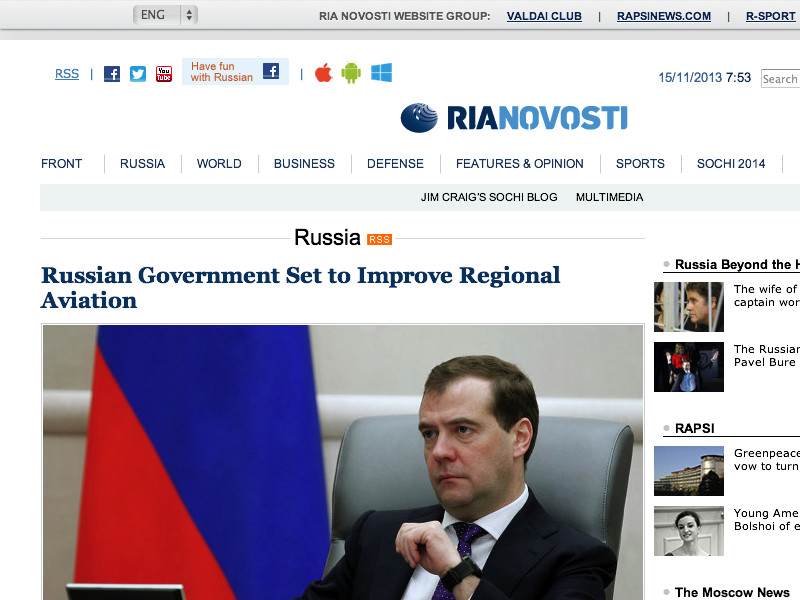
Russia’s Far East Aviation Needs Addressed by Prime Minister Dmitry Medvedev

News Analysis: Russia’s Far East Aviation Needs must be promptly developed per the instructions of  Prime Minister, Dmitry Medvedev. Since this rugged area encompasses over five million square miles and has Winter Temperatures that readily exceed -53C [-65F], travel by aircraft is imperative. Aircraft Selection is a very important element for the  proper development desired by the Russian Government. For example, a Turboprop Aircraft, which is less expensive than a Jet, has its Operational Design Parameters suitable for: short runways, adequate rates of climb, and reliability in this type of often frigid environment.

Another benefit of  a metal aircraft is if it  has landing gear failure, the fuselage merely collapses [whereas Composite Craft will Shatter like an Egg Shell [especially when ‘Cold-Soaked’)].

Metal aircraft, for “Siberian” [Far East] operation are the  reliable choice for air transit in the Severe Winter Environment.  “Cold Soaking” is much less of a problem than on a “Composite Fuselage” Aircraft. In any event, by applying Mega-TempTM Aircraft Insulation to the Interior of the Fuselage, the aircraft will consistently stay warmer in ANY cold temperature forecasted. A warmer cockpit will allow for instrumentation to operate properly when cold starting the airplane up as well. If, an aircraft has power loss, passengers will stay warmer inside  the Mega-TempTM Treated Cabin than with other Insulation Products.

Also, to be beneficially installed, application of Mega-TempTM Insulation to new Airport Buildings will keep them warmer in the winter.
Private investors, can successfully create a Business Model that will bring them  into this Major Undertaking. Investments in funding of existing Russian Aircraft Airlines or Operators [large or small] or in Airport Construction are possibilities.

The Russian Far East offers an enormous number of Investment Opportunities for those who want to Economically Prosper. Russia’s able leadership can help facilitate the process for Investors.

Reference: http://tinyurl.com/lh9wqk7
Airline Order Smaller Aircraft Passenger Seats for More Revenue

News Analysis:  The smaller seats, particularly in “Coach Class”, while allowing the airline to carry more passengers, increase customer dissatisfaction due to physical discomfort of the passenger seats. Since many airlines always ask: “What are the other airlines doing?” they follow the leaders [by installing narrower seats] rather than lead the followers [with installation of wider seats]. An innovative management of an airline should realize that passenger comfort is an important goal to develop repeat customers.  Rather than trying to put “many sheep in the barn” they should attempt to provide their customers with “Coach Class Comfort Second To None”. In the long term, those airlines will prosper with both repeat customers as well as new customers who are tired of being treated like sheep at other airlines.

Reference: http://tinyurl.com/kkccjd4

How to Scrap a Composite Commercial Aircraft

News Analysis: A “25 to 30” year life [or sooner] of composite aircraft necessitates they be environmentally disposed.

Carbon/Carbon aircraft have inherent problems not found with metal aircraft [such as delamination due to stress or  to high energy solar exposure while in flight]. The U.S. Air Force spends millions of dollars a year on composite fuselage protection of the B-2 Bomber. Now, it is seeking $55 Billion for a new bomber.

Perhaps: A possibly shorter life expectancy; more costly fuselage repairs [from the aforementioned]; and, ‘Egg Shell’ disintegration if there is a failure of the landing gear to work causing a “belly landing” will get airlines to re-think. Now, the public will be subjected to ‘repairs’ of damaged commercial aircraft not time-tested by the Airframe.

The airlines being  enamored with the marketed value of a “lighter aircraft” that ‘will reduce fuel burn’ is out of balance with the other issues mentioned. Additionally, the price of fuel is based on supply and demand like any other commodity. New sources of supply of oil are forthcoming presently. The price of aviation fuel will reduce as the supply is increased. Then, how valuable was the fuel cost element compared to the hundreds of millions of dollars spent for the ‘Composite’ aircraft and its inherent frailties?  Reality.

Reference: http://tinyurl.com/n457u4r