They Tell Them What They Want Them To Hear (Not What They Need To Know)

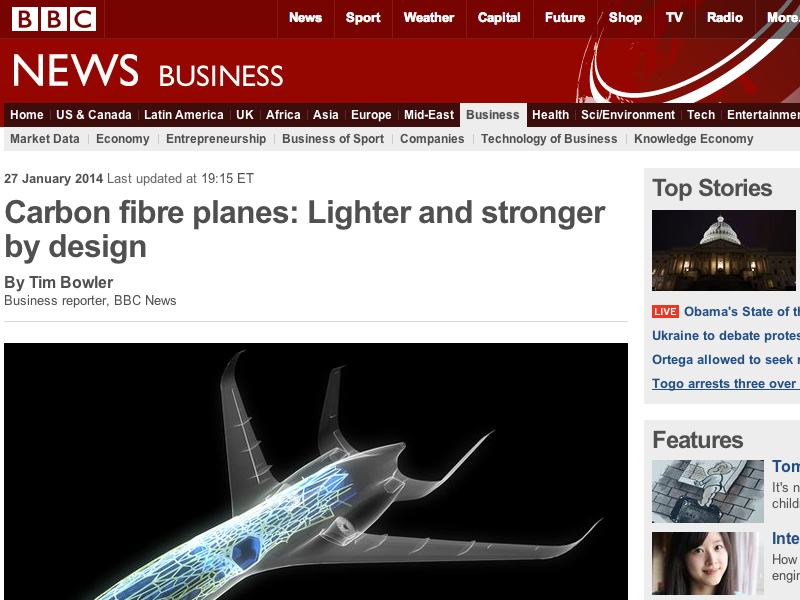
News Analysis: The Myopic Marketing Machinations regarding the use of Composite Materials for Aircraft Construction as touted by Airframes and their Mass Media Minions discuss weight reduction compared to Metal Aircraft. While there will be some weight savings between the materials, as well as some design allowances which are more difficult to achieve with Metals, there are some Key Drawbacks which are typically not discussed.

There are Three Main Problems with Composite Civil or Commercial Aircraft: De-lamination, Detonation, and Flammability.

De-lamination: Stress applied to Composite materials can, over time, make the Carbon/Carbon Textile Fabric  de-laminate from other conjoining Fabric. De-lamination makes the sturdiness of the Composites ‘disappear’ to the point of being as strong as a piece of soft fabric. As used in the structure of a fuselage or Wing Box, this could be Catastrophic in flight. It no longer has the strength of the fabricated “Vacuum Bagged and Autoclaved ” original structure.

Secondly, Long Term Exposure to Cosmic and Solar Radiation of a Composite Aircraft in High Altitude Flight will eventually weaken the adhesive thereby allowing Fabric De-lamination to occur.

Thirdly, allegedly, the U.S. B-2 Stealth Composite Bomber has had issues over its ‘brief’ life. The U.S. Air Force is presently seeking funding for a replacement of this Vaunted Aircraft. It is too expensive to maintain and has a shorter life expectancy than Metal Aircraft (is what has been reported in the media). The Leading Edges of the Wings need to be constantly examined for Surface Deterioration from  flying in the skies with particulates in the air.

The American led  Gulf War with Silica Sand particles in the air damaged the B-2’s in their flights from Whiteman Air Force Base in Missouri, U.S.A., to Iraq and back. U.S. Air Force Line Maintenance Personnel were quite chagrined by this reality it has been widely reported. What can Airlines expect of this Composite Behavior in flight  that would be different from the U.S. Air Force experiences? The Commercial Airlines will not fly in the Middle East? Hardly.

Detonation: Composite Aircraft cannot land on Airport Runways if they have Landing Gear Failure for example, without detonating the Composites into many Shards (as in an Explosion). Like an Egg Shell that destructs when smashed against something, so too will the underside of a Composite Aircraft have those portions of itself thrown all over a runway. A Metal Aircraft “dents”; a Composite Aircraft “explodes”, in effect.

Flammability: Carbon/Carbon Fabric and Petrochemical Adhesives used to ‘Glue an aircraft together’ are Flammable. The recent Small Battery Episodes causing fire to the Composite Airliners, for which they were grounded for months is a good example of this FACTUAL INHERENT MATERIALS’ LIABILITY. A Small Battery caused extensive aft fuselage damage to an Ethiopian Airlines Aircraft at Heathrow Airport in England. It reportedly took TWO MONTHS for the Airframe to ‘Secretly Repair” the damage. In fact, allegedly NO data as to the Repair Process has been disseminated to the Public nor to other Airlines. Why is that? What does the Airframe NOT WANT potential Customers to know? people ask.

If an Engine Detonation were to occur in flight and hot pieces of the engine (much hotter than a little battery) were to strike the Wing or Fuselage, a fire would be possible. A defective Microwave Oven used in the Galley could overheat, creating a possible fire in the fuselage.

What if the Auxiliary Power Unit were to catch fire and one was flying in such a Composite Aircraft over the Pacific Ocean, far from any airport, at night with a storm occurring below?

Flying into a storm may be hazardous in such a scenario and the greater atmospheric pressure of lower altitude might expand the fire due to more oxygen being present; a possible scenario

METALS IN AIRCRAFT ARE NOT FUEL SOURCES FOR FIRE, Carbon/Carbon Fabrics and the Petrochemical Adhesives ARE; This is not Clever Marketing But Real-World Science.

The Specious Argument of “Weight Savings for Fuel Savings” has a nice sound to it, but ignores the Composite Aircraft Realities of De-lamination, Detonation, And Flammability.

One must ask: “Is Aircraft Safety More Important to Society than Some Fuel Savings to An Airline?”  The answer from Men of Good Conscience is “Safety Wins”; For those who choose Fuel Savings, let them enjoy their potential “Fires in the Sky”.

To those who only write about Composite Aircraft Weight Savings, one must ask: “What about Composites’ Liabilities?”

We tell it as We see it; We are beholden to No One.

Reality is the truth.

Reference: http://www.bbc.co.uk/news/business-25833264

Ethiopian Airlines 787 Burn Repairs Are The Manufacturer’s Secret

News Analysis: The Heathrow, England fire debacle, allegedly caused by a small battery in the 787,  reportedly had Composite Panel and Structure Damage requiring a  TWO MONTH Repair. Since the Airframe is keeping the Repair Methodology Used A Secret. Airlines, who have purchased or may purchase such a Composite Aircraft, are reportedly dismayed at the “Blackout”.  

One may question: Why the repair took so long? and Why the Manufacturer went “Black” about the Repair Methodology. A person knowledgeable about Aircraft might think that the damage to the 787 was more severe than disclosed AND/OR more costly  than discussed.

If Airlines had Clarity about this entire Fire Event, they may seek the purchase of Metal Aircraft (perhaps a little heavier but not Flammable; as is both Carbon and Petrochemical Adhesives used to bond the Carbon together).

Transparency Is Utilized By Men Who Do Not Fear The Truth.

Reality. 

Reference: http://seattletimes.com/html/businesstechnology/2022625459_ethiopian787firexml.html

Qantas Airlines of Australia Is The World’s Safest Carrier

News Analysis: Over 60 years without a Fatality have given Qantas an enviable record other Airlines would love to emulate. In addition to Qantas for “Seven Star” Ratings are Air New Zealand, All Nippon Airways, Cathay Pacific Airways, Emirates, Etihad Airways, Eva Air, Royal Jordanian, Singapore Airlines and Virgin Atlantic.

It is unfortunate that Airlines, in the country of the biggest  Aircraft Company in the World, are not in this ‘Global Premier League’ as aforementioned. Perhaps the “Non-Premier” Airlines will eventually  realize that their chase for ‘Short Term Profits’ (so their Common Stock Prices rise) gets them NO Long Term Sustained Profitability. This because “Cheap Food, Poor Passenger Service, and Tardy Flights” divert customers elsewhere.

Reality.

Reference: http://www.airlineratings.com/news/201/qantas-the-safest-airline

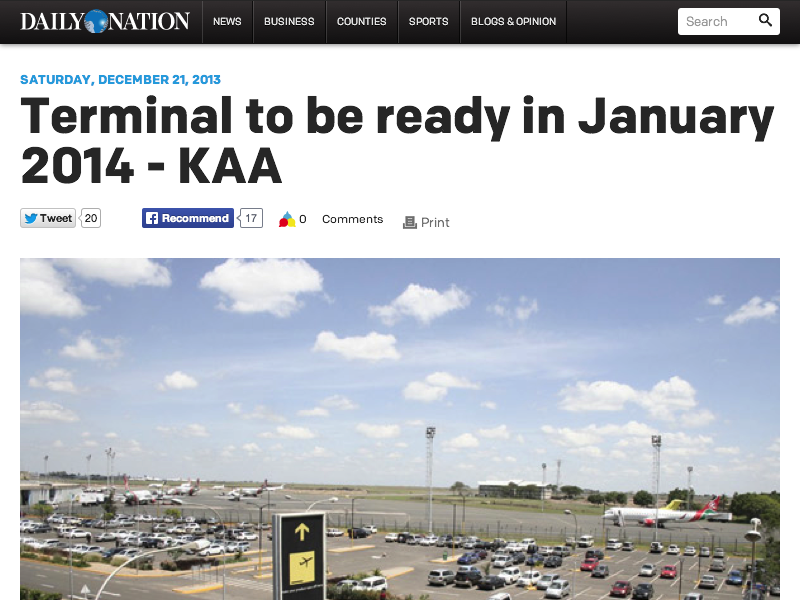
☆ Kenya’s Jomo Kenyatta International Airport To Open In January, 2014

News Analysis: Kenya’s Jomo Kenyatta International Airport will allow 2.5 Million passengers annually to alight in Nairobi: ‘The Green City In The Sun’. A new Terminal has been built and is expected to be ready to handle passengers in a few days.

Almost all areas of the Airport will be operational in a few days (excepting a terminal which had been damaged by fire).

This Airport in The Republic of Kenya, which consists of 580,000+km2 (224,000+ Mi2), will well-serve the country’s 44 Million inhabitants and Visitors.

Reference: http://www.nation.co.ke/business/-/996/2121452/-/h33tr1/-/index.html

★ Too Much Aerospace Technology May Create Aircraft Scatology

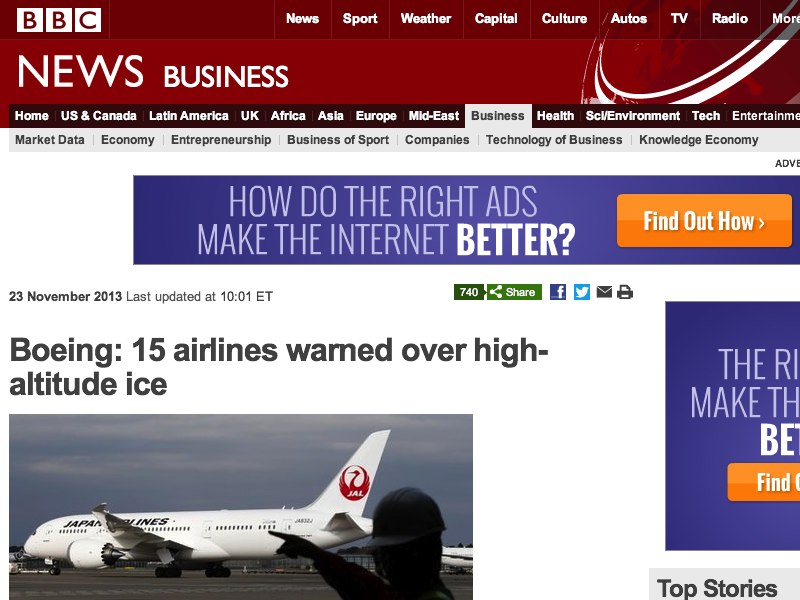
Premium News Analysis:  Too Much Aerospace Technology May Create Aircraft Scatology more people are thinking. Soon Airline Boards will have to admit that their Engineering Departments did not properly advise their Managements as to foreseeable flaws in New Airframe Design and Manufacture. The Boards themselves used very poor judgement in leaping on the Airframes’ ‘New Sell”: “Lighter Weight Cannot Wait” ‘LWCW’. Thus, ‘LWCW’ became the ‘Holy Grail’ in Aircraft Design.

Some Airframes took a ‘Greater Plunge” into ‘LWCW’ than others. Those who went “All In” are now suffering Aircraft Event by Aircraft Event. How did they go “All In” regarding Aircraft Weight ? Electronic Systems  replaced Hydraulic and/or Pneumatic Technologies in order to save weight; Carbon/Carbon Composites replaced Metals in Structure and Fuselage Exteriors; Four Engines were replaced by Two; Engines Components were designed to be lighter ‘not necessarily stronger’; Passenger seats were made Narrower and Thinner; Even, Blankets given out to Cold Passengers are not readily available; and so it goes. Does the Technology aforementioned make an aircraft better or does it make it more  ‘Scatologic’? Only time will tell.

Aircraft Fuel Consumption became the Cause Celebre of the Airline Boards. Airlines were told “Oil is going to $200.00 a Barrel”; it did not. The Changes made helped produce the present Conundrum of the Airframes: Aircraft Reliability is now being questioned; Justly so. Recurring Down-times support the Public’s Growing Concern.

The ‘LWCW’ had the intended effect desire by Retiring Airframe Executives: It elevated the prices of their Companies’ Stocks; the ‘LWCW’ was marketed to airlines. When the airlines ‘Took The Bait”, Airframe Executives  Self-Concern was Financially Rewarded. Some people say, this ideology moved the Aircraft world into its present condition. While others support the ‘LWCW’ principle by arguing that Military Aircraft have had similar technologies, they forget something important in Engineering. To wit, “Increases of Unit Scale May Bring Decreases in Unit Efficiency”. That which works for a physical smaller Fighter Plane exhibits different: Acceptable Research, Development, and  Production Costs, Expend-ability, Operational Parameters, Longevity, and other norms from large Commercial Aircraft. Governments pay for Military Aircraft while ‘Individuals’ pay for Commercial Air Planes.

An Apple is not an Orange; But Both are Fruit.

Reference: http://www.bbc.co.uk/news/business-25068222

English is the Global Language of Commerce

News Analysis:  English Is The Global Language Of Commerce and its Influence Is Omnipresent. Since success in Aviation, Business, International Relations, Sciences, Technologies, and the like are dependent upon Fluent Communication, learning this “Tongue” is mandatory. The ability to influence, and thereby coordinate the activities of others, revolves around their understanding of the communications and compliance there from.

The Diligent worked performed in both attaining the English Proficiency Data as well as displaying it coherently is to be commended.

Reference: http://www.multivu.com/mnr/62435-ef-education-first-top-english-speaking-countries